


People dislike losses twice as much as they enjoy gains. This lopsided fear of losing money makes investors uneasy when markets turn turbulent. Lately, concerns over tariffs have knocked the S&P 500 down 8%. Over the past year, though, the index has held steady. News outlets will dwell on the drop and ignore the broader picture. Best to turn off the TV for a while.
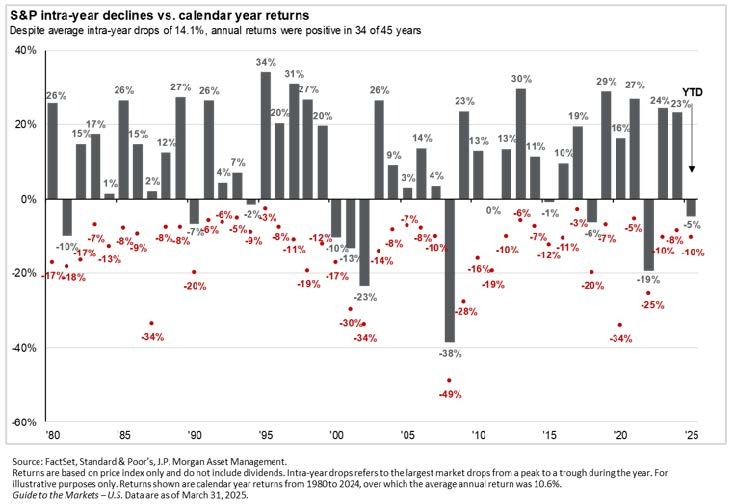
The full impact of tariffs, counter-tariffs, and political reactions is still unfolding. We're monitoring the situation closely. As investors react to each new headline, uncertainty will stir up more market swings. But market swings are nothing new. Sometimes, price discovery is smooth. Other times, like now, it's messy. Viewed through the lens of the next five years rather than the next five days, the volatility we experience over the short term isn't a bug in markets: it's a feature. Since 1980, the S&P 500 has seen an average intra-year decline of 14%. And yet, in 34 of those 45 years - three-quarters of the time - it ended the year higher. Those who sold in fear when prices dropped often regretted it. In times like these, the market becomes a place where wealth shifts from the impatient to the patient.
What matters most now is not how your investments behave, but how you do. Even rational people can make foolish choices under stress. Market corrections test an investor's nerve. If you checked your account balance daily this week with a knot in your stomach, you may not be as risk tolerant as you thought. The good news is, after back-to-back years of strong returns, you have time to adjust. The key is to have a plan before trouble arrives. Work with your Wealth Advisor to ensure your portfolio matches your comfort level. As J.P. Morgan once said, "In bear markets, stocks return to their rightful owners."
Travis Portwood, CFA, CFP®
Chief Investment Officer