


Markets are creatures of mood, forever swinging like a pendulum between hope and despair. Recent tariff provoked uncertainty serves as another example. On April 8th, the market told us American companies were worth $6 trillion less than the week before. On April 9th, between lunch and late afternoon, they gained $4 trillion in value. Label me a skeptic, but I doubt the actual cash-generating power of those businesses changed by 10% over a sandwich.
At an Amazon shareholder meeting in 2007, Jeff Bezos offered a bit of well-aged wisdom. He said, "People often ask what will change in the next ten years?" An honest question dripping with anxiety. But almost nobody, he noted, asks the subtler, wiser question: "What won't change?"
Amazon built its entire empire around three constants in human nature: people would constantly desire lower prices, broader selection, and faster delivery. Nearly two decades later, as artificial intelligence redraws entire industry maps, Amazon's strategy stands firm because Bezos didn't build Amazon on trends that might come and go. He built it around foundational truths. Investors should do the same.
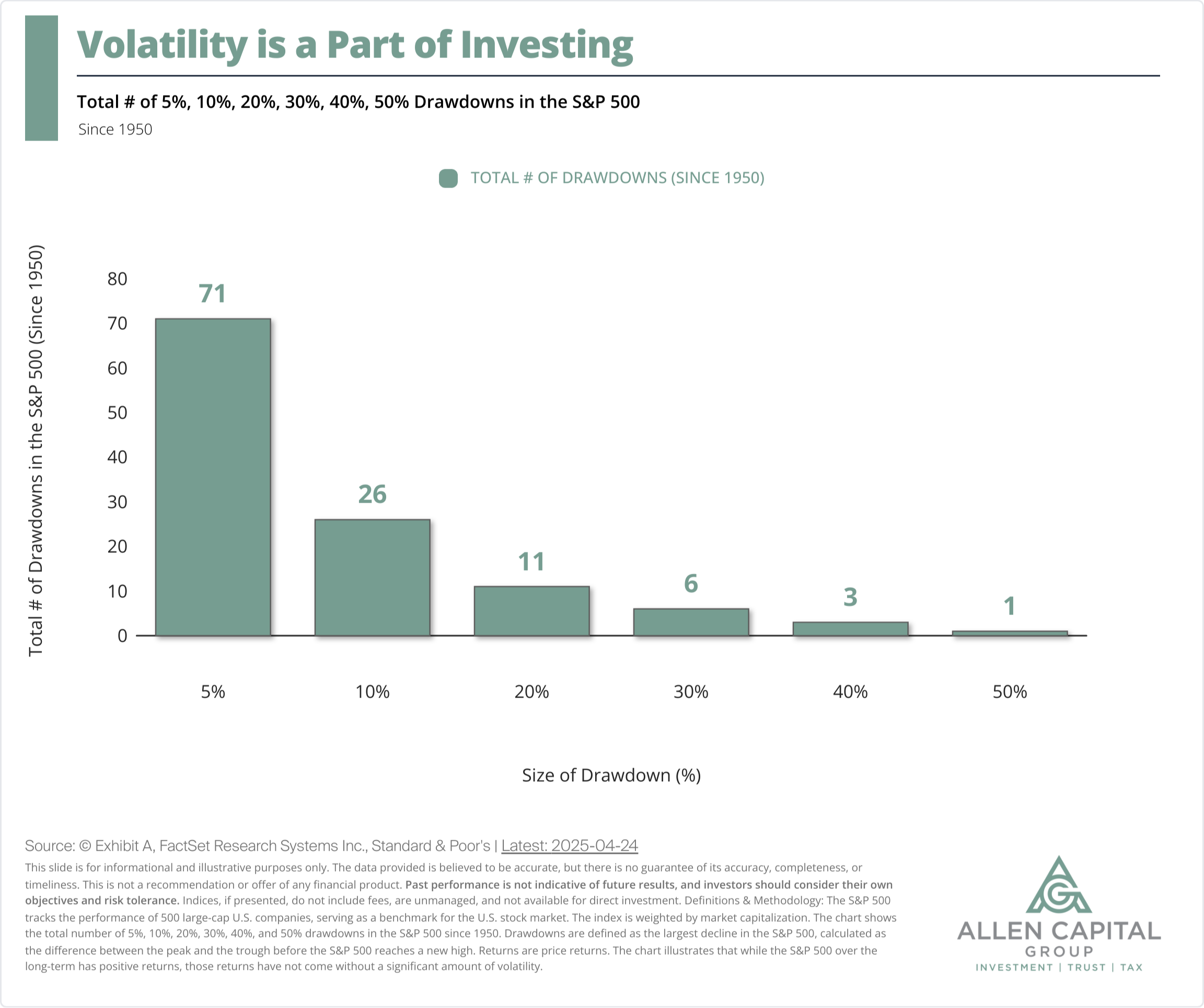
Volatility Is Normal - we've touched on this before, and it's worth repeating: when investing, volatility is part of the scenery. Since 1950, the S&P 500 has weathered no fewer than seventy-one drawdowns of 5%, twenty-six of 10%, and eleven of 20%—each a minor disruption in a long voyage. More episodes are on the horizon.
Learning not to flinch when volatility flares up is one of the last real edges for individual investors. This bravery begins with having a plan settled before the wind picks up. A well-prepared portfolio breeds patience, and in patience, opportunities often materialize, waiting to be seized.
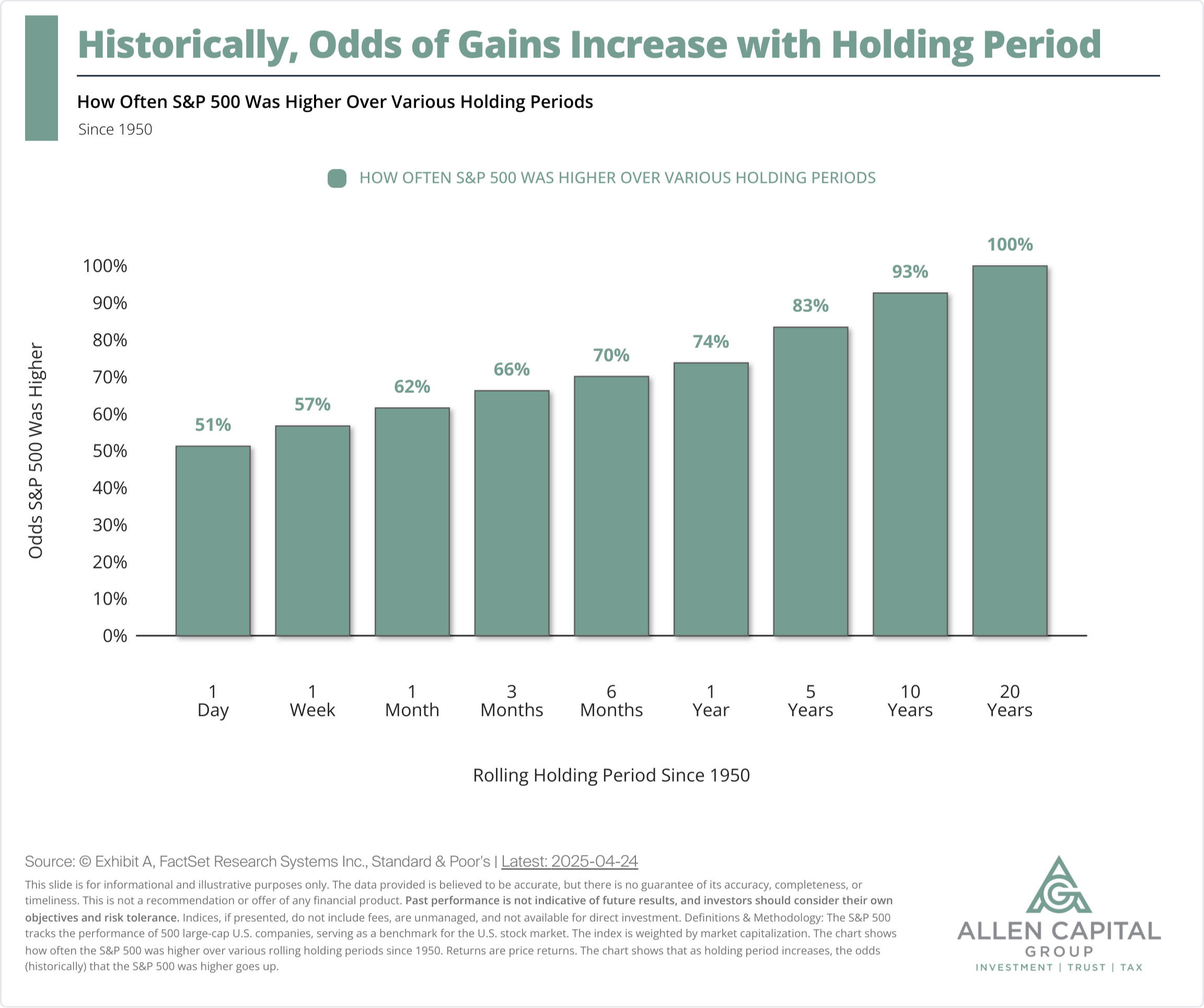
Long-Term Thinking Is A Cheat Code - To think long-term when investing is to give yourself an advantage so simple it often goes unnoticed. The longer you stay the course, the better your chances. Markets rise and fall with the moods of men, and in the short run, they can be as fickle as spring weather in Nebraska. But time has a steadying hand. One day in the market is a coin toss. Stay in a year, and the odds tilt your way—you come out ahead nearly three times out of four. Wait twenty years, and the record is perfect.
It's tempting to tinker with our portfolios in uncertain times—to make a change just for the comfort of motion. But motion isn't always progress, and activity isn't always wisdom. Once a portfolio is properly built to support your needs, wants, and wishes, there is little need for constant rearrangement. We may make the occasional adjustment—when opportunity knocks or when losses offer a silver tax lining—but we shouldn't trade for the sake of appearances. Restraint isn't a sign of neglect. It is a sign of care. There is dignity in stillness; sometimes, the wisest course is to hold steady. Patience isn't just a virtue in investing—it's the secret ingredient, the quiet force that does the heavy lifting.
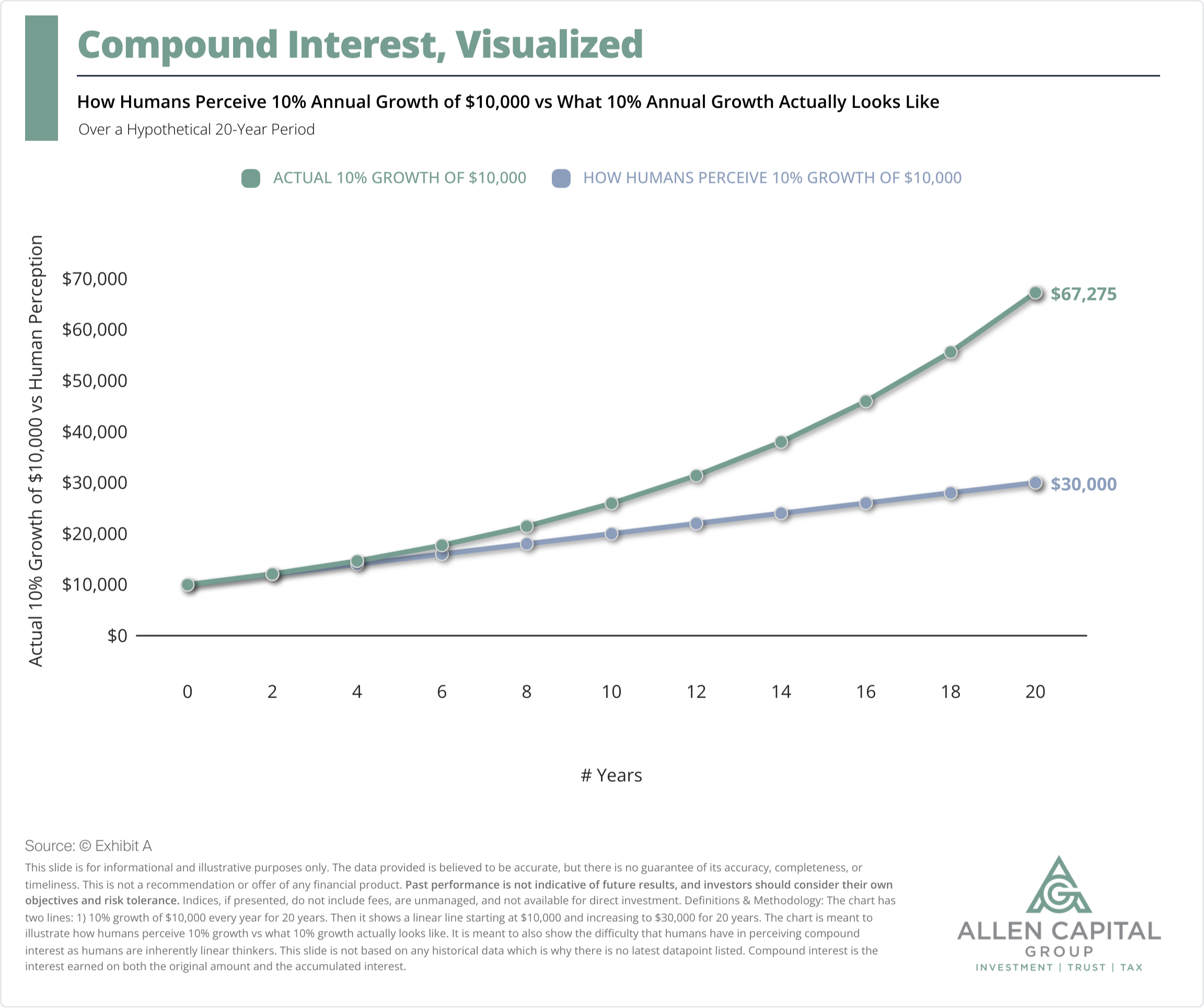
Compound Interest Is the 8th Wonder of the World - Humans are creatures of straight lines. We think in linear steps and inches that follow a predictable pattern. It's difficult for us to grasp the exponential nature of things that swell and stretch not by increments but by leaps. That's compound interest —a quiet force, often underestimated, always at work.
A compounding portfolio acts like a snowball rolling downhill, gathering size and speed, each turn pulling more into its orbit. What was once a small, unassuming amount grows into a figure of substance and strength. The most famous example is someone we are all familiar with, Warren Buffett. He accumulated the vast majority, about 99%, of his net worth after age 50. His wealth grew significantly in his later years, reaching $376 million at age 52, $620 million at 53, and $1.4 billion at 56. By age 66, his net worth was $17 billion; by age 72, it reached $35.7 billion.
Slow and steady effort, quietly compounded over time, can produce results beyond our imagination. But we'd also do well to heed Charlie Munger's advice: "The first rule of compounding is to never interrupt it unnecessarily."
Rather than trying to predict short-term market trends or chase the next "hot" stock, savvy investors focus on these time-tested truths—just like Amazon focused on customer constants. Chasing trends or reacting emotionally to market dips is a recipe for failure. The path to the future lay not in fevered speculation but in a shrewd reckoning with constancy. A long-term mindset—anchored to unchanging financial principles—is the key to real, lasting wealth.